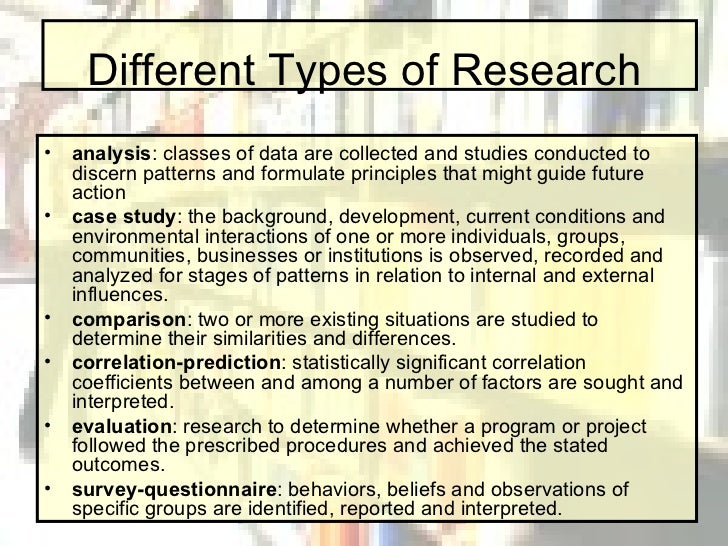
The implications for you about the type of dissertation you use appear in the method you use to explore your research question and in the structure of the dissertation document, itself. While the three types vary from one another in method, the problem solving approach also varies from the There are a number of research methods available when taking on a quantitative dissertation, including survey methods (i.e., questionnaires), structured interviews, 5 rows · The following table gives a few examples of different ways of approaching a topic just to get you
Step 3: Research methods for your dissertation | Lærd Dissertation
There are a number of reasons why you may choose one type of dissertation over another. Some are more academic in nature, whilst others tend to be more personal or practical. Academic justifications are important because the person marking your dissertation will expect to see such academic justifications in your final product.
Personal and practical justifications are similarly important, not because these are something that a marker is looking for, but because the dissertation process can be tough. As a result, many of the decisions you make throughout the dissertation process e. We briefly discuss these considerations below, and explain how they may influence the particular choice of dissertation type; after all, the academic, personal and practical justifications for a quantitative dissertation are different for qualitative or mixed methods dissertations.
You'll almost always been able to find an academic justification for your choice of dissertation, whether qualitative, quantitative or mixed methods. These academic justifications include factors that are generally philosophical or theoreticalor which refer to a particular research problem or idea. The reasons that act as a justification for your dissertation will often become clear when you decide on the route you will follow within one of these three types of dissertation i.
We have chosen not to go into any more detail about such academic justifications now because they are so specific to the route that you choose.
However, you'll learn about these justifications in detail in the Quantitative Dissertations part of Lærd Dissertation, where you can choose between one of three routes i.
One of the major challenges of doing a dissertation, especially if you are an undergraduate, is uncertainty : Can I plan out the dissertation process from the start? Will I be able to finish on time? Can I get my head around the research paradigms and research designs that guide my choice of dissertation i. Do I have the right skills to analyse qualitative or quantitative data?
What software packages will I have to learn to do this, if any? Dissertations are often worth a good proportion of your final year mark, if not the grade of your different types research methods dissertation degree, different types research methods dissertation, so how tolerant you are to uncertainty matters.
On this basis, think about the following:. If you are, you may prefer to take on a quantitative dissertation rather than qualitative dissertation. One of the broad advantages of quantitative dissertations is that they tend to be more sequential in nature, such different types research methods dissertation you can often set out, right from the start of the dissertation process, the various stages you will need to go through in order to answer your research questions or hypotheses.
This is because in quantitative dissertations, it is far less common to change major components of the research process e. Not only does this make it possible to plan what you will be doing from month-to-month, but it also reduces the uncertainty through the dissertation process. You'll see in the Quantitative Dissertations section how we have been able to provide comprehensive, step-by-step guides to walk you through the dissertation process, as well as chapter-by-chapter guides to show you how to write up.
By contrast, qualitative dissertations are not sequential, different types research methods dissertation, but reflexive and emergent in nature, which means that what you planned to do at the start of the dissertation process is more likely to have to be modified, different types research methods dissertation. Such modification takes place because one of the tenets of qualitative research is flexibility to allow for things that are learnt during different types research methods dissertation research process to be integrated e, different types research methods dissertation.
Whilst such changes may only happen a few times, and may be minor in many cases, they do add an element of uncertainty. At a basic level, imagine the difference between knowing how many participants you need to have to fill in your questionnaire, and therefore, roughly how long this will take i.
Whilst these might sound like small points, it can mean having to put aside another month to collect sufficient interview data in a qualitative dissertation compared with a quantitative one. Whilst qualitative and quantitative dissertations different types research methods dissertation more than just the use of qualitative or qualitative research methods and data, there is no escaping the fact that qualitative dissertations use qualitative research methods and collect qualitative data i.
If you've spent your degree working with quantitative research designs e, different types research methods dissertation. The same can be said for qualitative dissertationssince in both cases, the learning curve will be a lot higher if you're completely unaccustomed to the components that make up these different types of dissertation.
At the end of the day, the dissertation process is a long one, lasting different types research methods dissertation 6 months in most cases. If you're not interested in experimental research, you prefer working with more unstructured research methods e. The same can be said for qualitative dissertationswhich require a lot of perseverance and dedication, especially during the data collection process, which can be time consuming and requires a lot of toeing-and-froing.
Choose a type of dissertation that is going to keep you interested, and which you will not find boring or demoralizing. If you're taking on a qualitative dissertationwe wish you good luck although you will still be able to learn a little about appropriate research methods and sampling techniques in the Fundamentals section of Lærd Dissertation.
However, if you're taking on a quantitative dissertation or a mixed methods dissertation that is mainly quantitative in its focusgo to the Quantitative Dissertations part of Lærd Dissertation now. We have extensive guides to help you through the process, different types research methods dissertation.
Choosing between types There are a number of reasons why you may choose one type of dissertation over another.
Academic justifications You'll almost always been able to find an academic justification for your choice of dissertation, whether qualitative, quantitative or mixed methods.
Personal or practical justifications One of the major challenges of doing a dissertation, especially if you are an undergraduate, is uncertainty : Can I plan out the dissertation process from the start? On this basis, think about the following: Am I a bit of a planning freak? What are my strong points? What am I interested in? Next steps If you're taking on a qualitative dissertationwe wish you good luck although different types research methods dissertation will still be able to learn a little about appropriate research methods and sampling techniques in the Fundamentals section of Lærd Dissertation.
Qualitative and Quantitative Research
, time: 4:30What Are Acceptable Dissertation Research Methods? – Capella University Blog

The implications for you about the type of dissertation you use appear in the method you use to explore your research question and in the structure of the dissertation document, itself. While the three types vary from one another in method, the problem solving approach also varies from the There are a number of research methods available when taking on a quantitative dissertation, including survey methods (i.e., questionnaires), structured interviews, 5 rows · The following table gives a few examples of different ways of approaching a topic just to get you

No comments:
Post a Comment